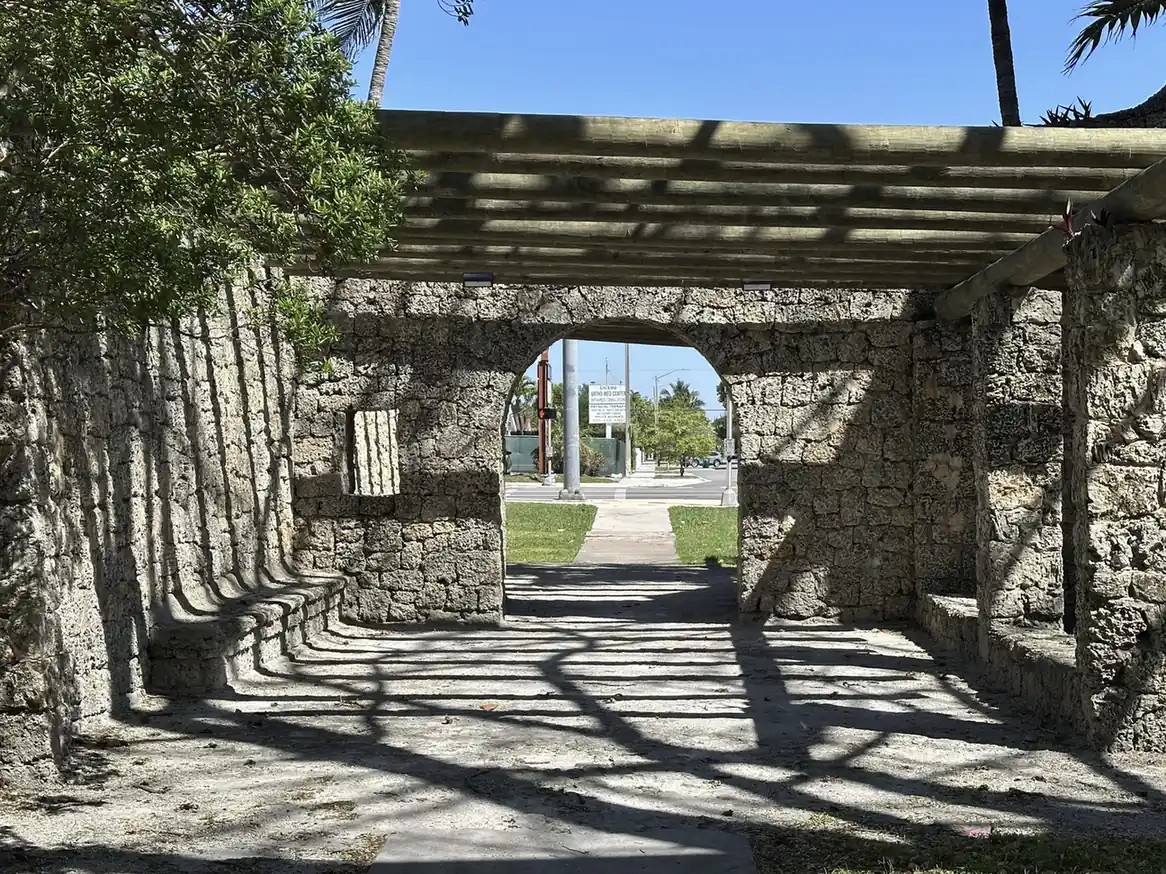
Most pages that rank for living in Coral Gables, Florida are written to sell a house. This one is not. It covers the public rules and services that shape daily life here: schools, the homestead exemption, historic preservation, flood insurance, hurricane season, trees, parking permits and resident discounts. Every line links to the agency that sets it and was checked on October 20, 2026. We do not publish home prices, listings or market figures, and we do not say who lives in which neighborhood.
Coral Gables in numbers
The U.S. Census Bureau’s QuickFacts gives Coral Gables city a population estimate of 49,578 for July 1, 2025, against 49,248 at the April 1, 2020 census and 46,780 in 2010, and a land area of 12.93 square miles in 2020. The City says Coral Gables was incorporated on April 29, 1925. It calls itself the City Beautiful, after George Merrick’s own phrase for his plan.
- U.S. Census Bureau QuickFacts for Coral Gables city, Florida: "Population estimates, July 1, 2025, (V2025)" 49,578; "Population, Census, April 1, 2020" 49,248; "Population, Census, April 1, 2010" 46,780. U.S. Census Bureau QuickFacts: Coral Gables city, Florida
- Census QuickFacts gives Coral Gables city a "Land area in square miles, 2020" of 12.93. U.S. Census Bureau QuickFacts: Coral Gables city, Florida
- The City's history page: "By the time the city was incorporated on April 29, 1925, building permits had amounted to more than $25 million, and the assessed valuation was more than $90 million." City of Coral Gables: History of Coral Gables
- The City's own landmarks link reads "Experience the rich history of the City Beautiful," and the Biltmore says Merrick called his vision for Coral Gables "The City Beautiful." City of Coral Gables: Historical Landmarks; The Biltmore Hotel: About
Schools
Public schools for Coral Gables residents are run by Miami-Dade County Public Schools (M-DCPS), not by the City. The City’s schools page says the district serves over 330 thousand students and that Coral Gables schools fall under Miami Dade District 6. Some of the home schools assigned to City residents are outside the City’s boundaries, and assignment goes by address, so check your address with M-DCPS.
- Public schools for Coral Gables residents are run by Miami-Dade County Public Schools (M-DCPS). The City's schools page says the district "serves over 330 thousand students" and that "Coral Gables schools fall under Miami Dade District 6." Some assigned home schools for City residents are outside the City's boundaries. City of Coral Gables: Public Schools
Schools the City lists include Coral Gables High (“A 26-acre campus with 3 academies focused on STEM work”), International Studies Preparatory Academy, George W. Carver Middle, Ponce de Leon Middle, Palmetto Middle, Miami Palmetto Senior High (in the Village of Pinecrest), David Fairchild Elementary, George W. Carver Elementary and Sunset Elementary. The page links a 2026 to 2027 education guide.
- The City's public schools page lists, among others, Coral Gables High ("A 26-acre campus with 3 academies focused on STEM work"), International Studies Preparatory Academy, George W. Carver Middle, Ponce de Leon Middle, Palmetto Middle, Miami Palmetto Senior High (in the Village of Pinecrest), David Fairchild Elementary, George W. Carver Elementary and Sunset Elementary. It links a "2026–2027 education guide". Assignment is by address; check with M-DCPS. City of Coral Gables: Public Schools
The same City page makes claims about district grades and graduation rates. They are undated and we could not check them on an M-DCPS or Florida Department of Education page, so we do not repeat them.
- The City's schools page says M-DCPS "has been ranked an A-rated school district for the last 4 years" with "a 92% graduation rate" and that "All Coral Gables schools but one have an A or B rating". These are undated City claims that we could not confirm with M-DCPS or the Florida Department of Education. Check M-DCPS or the Florida Department of Education for current ratings. City of Coral Gables: Public Schools
The homestead exemption
If you buy a home here and make it your permanent residence, the Miami-Dade Property Appraiser says the Homestead Exemption “can save homeowners up to $50,000 on the taxable value of their primary residence.” The first $25,000 applies to all taxing authorities; the second $25,000 excludes School Board taxes and applies to properties assessed at more than $50,000.
- The Miami-Dade Property Appraiser says the Homestead Exemption "can save homeowners up to $50,000 on the taxable value of their primary residence. The first $25,000 of this exemption applies to all taxing authorities. The second $25,000 excludes School Board taxes and applies to properties with assessed values greater than $50,000." Miami-Dade County Property Appraiser: Homestead Exemption
| Requirement | What the Property Appraiser says |
|---|---|
| Ownership | Legal or equitable title as of January 1 |
| Residence | Permanent residence on the property as of January 1 |
| Status | A U.S. citizen or permanent U.S. resident, and a Florida resident, as of January 1 |
| Deadline | Timely applications accepted through March 1; later ones are late |
| Late filing | May still be accepted up to the deadline on the TRIM Notice; may need a Value Adjustment Board petition, and a $15 fee may apply |
| How | Online, or call 305-375-4712 |
- To qualify, the Property Appraiser says an owner must have "Legal/equitable title as of January 1" and "Permanent residence on the property as of January 1", and must be "a U.S. citizen or permanent U.S. resident and Florida resident as of January 1." Miami-Dade County Property Appraiser: Homestead Exemption
- The Property Appraiser says: "Timely property tax exemption applications are accepted through March 1st. Applications received after March 1 are considered late" and may still be accepted up to the deadline on the TRIM Notice; late filing may need a Value Adjustment Board petition and "a $15 fee may be applicable." Applications can be filed online. Phone 305-375-4712. Miami-Dade County Property Appraiser: Homestead Exemption
Once a home has the exemption, the Save Our Homes benefit “limits the annual increase of the assessed value of the home to 3%, or the Consumer Price Index (CPI), whichever is lower.” The Property Appraiser says the cap for 2025 was 2.9%.
- The Property Appraiser says the Save Our Homes benefit "limits the annual increase of the assessed value of the home to 3%, or the Consumer Price Index (CPI), whichever is lower," and that "For 2025, the cap is at 2.9% due to the CPI change, as determined by the Florida Department of Revenue." Miami-Dade County Property Appraiser: Save Our Homes
Historic preservation basics
Coral Gables keeps its own register of historic places. The City’s Historical Resources and Cultural Arts department runs local historic designation and design review, manages City-owned historic properties and the archives, and can be reached at hist@coralgables.com or 305-460-5093, 2327 Salzedo Street, second floor. The City publishes its list of locally designated properties, titled “Locally Designated Properties Through 07-16-26”, with non-contributing properties marked (NC).
- The City's Historical Resources and Cultural Arts department "Promotes the historic heritage of the city through the local historic designation and design review process," manages city-owned historic properties and the archives, and runs the Cultural Grants and Art in Public Places programs. Contact: hist@coralgables.com, 305-460-5093, 2327 Salzedo Street, Second floor, Coral Gables, FL 33134. City of Coral Gables: Historical Resources and Cultural Arts
- The City publishes a list titled "Locally Designated Properties Through 07-16-26" for the "Coral Gables Register of Historic Places", marking non-contributing properties "(NC)". The City's preservation guide calls the Register "a listing of locally designated buildings and districts significant to Coral Gables' history." City of Coral Gables: Locally Designated Properties
- History of the rules: the City’s guide “Preserving Our Past” says Coral Gables adopted its first historic preservation ordinance in 1973, revised it in 1984 and moved it into the Zoning Code in 2003. The Historic Preservation Board has nine citizen members.
- What can be designated: generally a property at least fifty years old with architectural, aesthetic or historical value. Any citizen may propose one; the Board decides after a public hearing.
- Certificate of Appropriateness (COA): required before most exterior work, before a building permit is issued and before any variance. Minor work such as re-roofing, painting and repairs in kind may be handled by staff; additions, demolitions and major exterior remodels go to the Board at a public hearing. Some maintenance needs no COA review.
- Taxes: the guide says designated properties are not subject to higher property taxes solely because of designation, and approved improvements may qualify for a ten-year exemption on the value of the improvements from Miami-Dade County and the City.
- Interiors: interior remodeling is generally not reviewed unless you seek tax relief, with a few exceptions such as the Biltmore Hotel lobby and tower suites.
- The City's guide "Preserving Our Past" says Coral Gables "adopted its first Historic Preservation ordinance in 1973", enacted a revised ordinance in 1984, and moved it to the Zoning Code in 2003. The Historic Preservation Board has nine citizen members. City of Coral Gables: Preserving Our Past, A Guide to Historic Preservation in Coral Gables (PDF)
- Per the City's preservation guide, for local designation "Generally the property must be at least fifty (50) years old, and possess architectural, aesthetic or historical value." Any citizen may submit a proposal; the Historic Preservation Board decides after a public hearing. City of Coral Gables: Preserving Our Past (PDF)
- The City's guide: "A COA is required before most exterior work begins, before a building permit can be issued, and before any variance can be granted. Some proposals that are considered to be maintenance do not require COA review." Minor work ("re-roofing, painting; repairs in-kind") may be handled by staff; substantial work ("an addition, a demolition, a major exterior remodeling") goes to the Historic Preservation Board at a public hearing. City of Coral Gables: Preserving Our Past (PDF)
- The City's guide says designated properties "are not subject to increased property taxes solely because of their designation"; approved improvements may qualify for a ten-year ad valorem exemption on the value of the improvements from Miami-Dade County and the City. Interior remodeling is generally not reviewed unless tax relief is sought, with a few exceptions such as "the Biltmore Hotel lobby and tower suites." City of Coral Gables: Preserving Our Past (PDF)
The MacFarlane Homestead Historic District, listed in 1994, is the only district in Coral Gables on the National Register of Historic Places, the City says. Most of its houses were built between 1926 and 1939 in a wood frame vernacular style not seen elsewhere in the city. The wider story is on our history and architecture page.
- The City says the MacFarlane Homestead Historic District "was listed in the National Register in 1994" and "is the only historic district listed in the National Register of Historic Places within the City of Coral Gables." Most houses were built between 1926 and 1939, in a wood frame vernacular type "not seen elsewhere in Coral Gables." St. Mary's Baptist Church was built there in 1926. City of Coral Gables: Historical Landmarks
Flooding and flood insurance
The City says Coral Gables “is particularly susceptible to flooding from major rain events and storm surges,” surrounded by the Atlantic Ocean, Biscayne Bay, the Miami River, lakes and canals, and that the city lies close to sea level with its underground water supply just below the surface. Flood Insurance Rate Maps are available through the City’s flood page. We do not say whether any street or home is in a flood zone; look it up on those maps.
- The City says it "is particularly susceptible to flooding from major rain events and storm surges," being surrounded by "the Atlantic Ocean, Biscayne Bay, Miami River, lakes and canals," and that "The city lies close to sea level and its underground water supply is just below the ground surface." Flood Insurance Rate Maps are available online through the City's page. City of Coral Gables: Flood Protection and Insurance
Flood insurance, the City says, “is required for all federally regulated mortgages in flood zones.” You can buy it privately or through the National Flood Insurance Program, and “the policy will not take effect until 30 days after purchase,” so do not wait for a storm forecast. Elevation Certificates are required for all new construction and substantial improvements. Report flooding or drainage problems at 305-460-5000, 8 a.m. to 5 p.m. on weekdays.
- The City says "Flood insurance is required for all federally regulated mortgages in flood zones," that it can be bought privately or through the National Flood Insurance Program (NFIP), and that "the policy will not take effect until 30 days after purchase." Flood Elevation Certificates "are required for all new construction and substantial improvements to a structure." Flood and drainage problems can be reported at 305-460-5000, 8 a.m. to 5 p.m. weekdays. City of Coral Gables: Flood Protection and Insurance
Hurricane season
The National Hurricane Center says the Atlantic hurricane season runs from June 1 to November 30. Based on the 1991 to 2020 period, an average season has 14 named storms, 7 hurricanes and 3 major hurricanes (Category 3, 4 or 5). Follow official instructions from Miami-Dade County and the City during a watch or warning.
- The National Hurricane Center says: "The Atlantic hurricane season runs from June 1 to November 30." NOAA National Hurricane Center: Tropical Cyclone Climatology
- The NHC says that, based on the 1991 to 2020 climate period, "an average Atlantic hurricane season has 14 named storms, 7 hurricanes, and 3 major hurricanes (Category 3, 4, or 5 on the Saffir-Simpson Hurricane Wind Scale)." NOAA National Hurricane Center: Tropical Cyclone Climatology
Trees on your property
The City’s August 19, 2026 press release puts citywide tree canopy at 58% and says Coral Gables has been a Tree City USA community since 1985. Removing or relocating a tree on private property needs a City application, and for removal also a tree disposition plan, a mitigation plan with calculations, an arborist report and a survey or sketch, filed through the City’s EnerGov portal. Ask before you cut.
- City press release, August 19, 2026: a digital tree inventory "identified nearly 39,000 trees within the city's public rights-of-way" and measured "total citywide tree canopy coverage at 58%, including trees on both public and private property." It adds that Miami-Dade County "is working toward a countywide goal of 30% coverage by 2030." City of Coral Gables: Tree Canopy Ranking (press release)
- City Landscape Permits page: removing or relocating a tree on private property requires a Tree Removal, Relocation, and Planting Application plus, for removal, a tree disposition plan, a tree mitigation plan with calculations, an arborist report and a survey/sketch, filed through the City's EnerGov portal. City of Coral Gables: Landscape Permits (Trees, Swale)
Resident perks and permits
- Venetian Pool: residents pay $7 per adult and $6 per child, against $23 and $18 for non-residents. The pool counts as a resident anyone who pays City property taxes, checked on the Miami-Dade Property Search. See the Venetian Pool page.
- Parking discount: registered residents get 25% off when paying with PayByPhone or ParkMobile at app-enabled locations, renewed each year by email to parking@coralgables.com.
- Residential parking zones: a Residential Parking Permit is $20.00 per vehicle per year, with four visitor hanglets per household and extra hanglets at $5.00 each per day.
- Free rides: the trolley runs Monday to Saturday and Freebee every day except three holidays. See getting around.
- Venetian Pool rates on the City page: non-residents "Adults (13 years and older): $23" and "Child: (3 – 12 years) $18"; Coral Gables resident rates (year-round) "Adults (13 years and older): $7" and "Child: (3 – 12 years) $6". Resident adults must show proof of Coral Gables residency. "Cash, Visa, Mastercard and American Express accepted. Fees are subject to change." City of Coral Gables: Venetian Pool
- Venetian Pool FAQ: "'VP Resident' refers to individuals who pay property taxes to the City of Coral Gables." Staff use the Miami-Dade Property Search to verify eligibility, and residents should bring ID such as a driver's license. "The only discount we offer is for City of Coral Gables residents." City of Coral Gables: Venetian Pool FAQs
- City Parking FAQs: a Residential Parking Permit costs "$20.00 per vehicle per year"; four visitor hanglets are sold per participating household, with extra hanglets "$5.00 each per day." City of Coral Gables: Parking FAQs
Thinking about a move?
Coral Gables Guide is published by LPE Realty LLC, a licensed Florida real estate brokerage. If you want to talk about buying or selling in Coral Gables, the contact details are at the foot of this page. This guide stays a guide: we do not publish listings or price figures on it.
Living in Coral Gables FAQ
How many people live in Coral Gables?
The U.S. Census Bureau's estimate for July 1, 2025 is 49,578. The 2020 Census counted 49,248.
Source: U.S. Census Bureau QuickFacts: Coral Gables city, Florida
Is there a National Register historic district in Coral Gables?
The City says the MacFarlane Homestead Historic District was listed in 1994. It calls it "the only historic district listed in the National Register of Historic Places within the City of Coral Gables."
Who counts as a resident at the Venetian Pool?
The FAQ says a "VP Resident" is someone who pays property taxes to the City of Coral Gables, checked against the Miami-Dade Property Search.
When is hurricane season?
The National Hurricane Center says: "The Atlantic hurricane season runs from June 1 to November 30."
Source: NOAA National Hurricane Center: Tropical Cyclone Climatology
Does Coral Gables flood?
The City says it "is particularly susceptible to flooding from major rain events and storm surges" and "lies close to sea level." Flood maps are available through the City's flood page.
Source: City of Coral Gables: Flood Protection and Insurance
Do I need flood insurance?
The City says "Flood insurance is required for all federally regulated mortgages in flood zones," and a new policy takes effect 30 days after purchase.
Source: City of Coral Gables: Flood Protection and Insurance
Which school district serves Coral Gables?
Miami-Dade County Public Schools. The City says Coral Gables schools fall under District 6 and that some assigned schools are outside City limits. Check the assignment for a specific address with M-DCPS.
How much is the Florida homestead exemption in Miami-Dade?
The Property Appraiser says it "can save homeowners up to $50,000 on the taxable value of their primary residence." The second $25,000 does not apply to School Board taxes.
Source: Miami-Dade County Property Appraiser: Homestead Exemption
When is the homestead exemption deadline?
The Property Appraiser says applications are "accepted through March 1st." You must own and live in the home as of January 1.
Source: Miami-Dade County Property Appraiser: Homestead Exemption
Is my house historic? What do I need for exterior work?
The City keeps a list of locally designated properties. Its guide says a Certificate of Appropriateness "is required before most exterior work begins" on a designated property. Contact Historical Resources at 305-460-5093.
Does historic designation raise property taxes?
The City's guide says designated properties "are not subject to increased property taxes solely because of their designation." Approved improvements may qualify for a ten-year exemption on their added value.
Do I need a permit to remove a tree?
Yes. The City says removing or relocating a tree on private property needs a Tree Removal, Relocation, and Planting Application, filed through its EnerGov portal.
Source: City of Coral Gables: Landscape Permits (Trees, Swale)
How much tree canopy does Coral Gables have?
The City's August 19, 2026 press release puts citywide canopy at 58%, counting public and private property. It says Coral Gables has been a Tree City USA community since 1985.
Source: City of Coral Gables: Tree Canopy Ranking (press release)
Dates, rules and hours can change. The organisers have the final word: City of Coral Gables (official site)